Sunday, June 3, 2012

My Italian Workout

[Warning: May contain graphic details of relationship with husband or other current spouse of the male species.]
 My husband is a workout kind of guy. He bikes, hikes, lifts, paddles, skis, glides on a nordic track for  at least 2 1/2 hours a day. Every day. Mind you, I don't mind. He's beautiful. Muscular, well-toned, strong: the kind of alpha guy a gal like me, described by a one of my gay amica's as "the most heterosexual woman I know" , can appreciate. And he appreciates me with equal admiration of the way I've been able to stay in pretty good physical shape for an old broad. He'd like me to stay that way. He encourages me to work out. Yesterday he emailed me, from America, a link to a new workout program he discovered. It's called Tabata. I checked it out and it's, well, work. So I've designed my very own, integrated, every day maintenance regime. To whit:

The Mastrobuono Method for a Totally Toned Italianate Body in 90 Days or Less

Warm-up: Stairs. Run down steep, non-made-to-code spiral staircase to terrace below house to eat           breakfast and write. Forget glasses. Run back up. Run down. Hear cell phone ring. Run up. Run back down. Have to pee. Run up. Run back down. Repeat several times until it's too late to eat breakfast before the fish guy comes. Gulp down espresso.[Note: weight loss is extra bonus] Run down back stairs (also not made to code: each step is 6 feet high) to front door. Forget key. Run back up back stairs. Run down and out door.

Steep Spiral Staircase
Cardio: Hear cheesy Italian music fish guy plays from tinny speakers on his truck fade as he pulls away. Sprint half a kilometer to the other side of town to catch him. Pause to buy calamari. Hear church bells chime 8:30 and realize your guests are now up and you haven't yet made coffee. Sprint back to house, now with calamari as weights.
Steep stairs


Recovery: See guests headed out of town for the day. Notice mountains are in clear view this morning. Stop at bar on the way back to house to take them in with a capuccino.

Steep street
Lifting: Schlep three, 15-pound bags of potting soil from the blue dolphin (pet name for the car. It's really, really blue!) parked at bottom of long hill to house. Carry them up back stairs and then down spiral staircase. Do two reps.
Heft 5-liter wine jugs of water from bathroom down spiral staircase to newly planted shrubs on terrace because outside faucet seems blocked. (Note to self: include call to plumber in cool down.) Do four more reps.

Cool-Down: Fire up internet and look at Tabata site lovingly sent by spousal until. Eat.

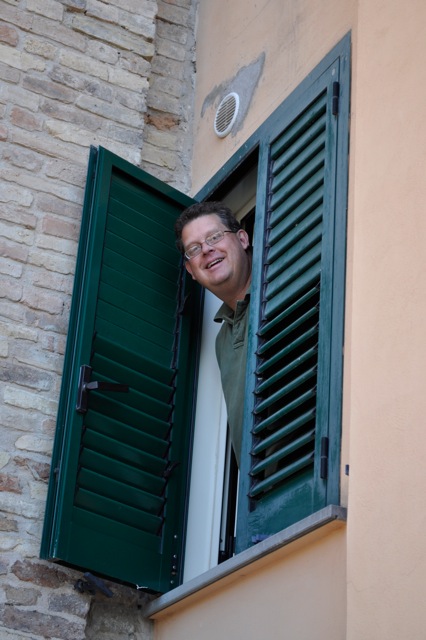
Spousal Unit of the Alpha Male Variety (One friend of mine said he is built like and action-hero figure)


Friday, May 25, 2012

It's the Journey, Stupid!

Well, I'm home. Sono tornata alla mia casa Italian. I've returned to my Italian house. It was quite a journey to get here. A car. A train. A train. A plane. A tram. A plane. A tram. A bus. and another bus. It seemed interminable and tiring, and, well, yes, even questionable. Usually I can sleep on a transatlantic flight. I just pop a sleep aid in the mouth (Note to censor: These are legal, over-the-counter wimpy knock-offs of their more potent prescription cousins). My husband takes enough of them every night to sedate and secretly invade Uzbekistan and they don't do a darn thing to him. I, on the other hand, pass one under my nose and immediately zonk out on the very ground on which I am standing and can be roused only if a nuclear warhead lands beside my right ear. But on this particular flight, I decided to ingest TWO pills to put me out extra fast because it was a short flight. The problem was my timing. I figured I could take the stuff and use the time it takes to work to go pee before I hit dreamland. But wait! The flight attendant is serving drinks! The nice Polish couple sitting on the aisleside of my window seat order. She: TWO cokes. He: A small bottle of wine. Now these guys are European. They don't gulp drinks like Americans do. They sip. They savor. They take their TIME. In the meantime, both my bladder and my lids are becoming quite heavy. But there is no way I can squeeze past the barrier of their non-upright tray tables. I wait. Finally, the woman finishes her second can of coke. And hands the "rubbish" (it's not "garbage" mind you, because we are on a British Airways flight.) to the flight attendant. I'm so close! But the man lingers over his wine. And lingers. And lingers. Right up until the onboard meal is served.
"Curried chicken or vegetarian pasta?" chirps the eerily cheerful attendant.
"LOO!" I want to scream (because, mind you, we are on a British Airways flight).
But I'm hungry. The two hard-boiled eggs I'd brought along and eaten at 4 PM to tide me over until we landed 9 hours later weren't cutting it. I wolf down the curried chicken.
The man and woman BOTH have wine. She: white. He: red. And after eating, since they are European, the order coffee. Two cups each. Consecutively. My chin is bobbing repeatedly towards my chest and I remain conscious only because it awakens me each time it smacks against my sternum and because of the excruciating pain in my bladder. But the Polish couple's tray tables are still down, allowing them to pick at their dessert (chocolate cheesecake. I had no room for it because my swelling bladder had reduced my stomach to the size of an olive pit.) Meantime, the "time to destination" clock on my seatback screen ticked down the minutes and hours until our landing: 5:28, 5:08, 4:50, 4:32. At 4:15 to go, the angel of an attendant removed all our trays and I fled beyond the aisle barriers to the restroom. At about 4:03 until arrival, I finally allowed my eyes to shut. Let the nukes begin! HAHA! But less than 3 hours later it wasn't the nukes that pulled me back to this world, it was the smell of coffee triggering minor tremors in my stomach. I was hungry again. I slipped of my eye mask and earplugs and accepted that there would be no bragging rights about my sleeping prowess generated by this flight.
Sleep deprivation is not my strong suite.
London's Heathrow airport is a vast shopping mall with occasional nods to the world of flying. [Sign: Be sure to allow enough time to board your flight. Travel time to Terminal C - 15 minutes by tram]. I may as well have been walking to Rome. The two bowling balls strapped to my body disguised as a laptop and messenger bag respectively slowed my movements to a crawl. I forgot that an escalator is a set of MOVING stairs and was nearly propelled face-first down them. I dropped a book I had bought at Philly International on the "off" chance I's have non-sleep time on the flight. By the time I realized it was gone, I had to back track through the security line and re-enter it. When I bent over to retrieve it, one of the aforementioned bowling balls whacked me in the nose. Red-nosed and bleary-eyed, I saw a security guy  eyeball me warily. I wanted to ask him to let me curl up in one of the trays. And I still had a plane, a tram, a bus, and a bus to go. Fortunately, sandwiched between brief required waking periods, there was some sleep on those modes of carriage. But by the time I arrived at my front door, lugging the bowling balls and a "rolling" (dragging!) duffle, I was paid a sharp visit by the Angel of Doubt. Is this trip REALLY necessary? Please just make it end!
I reached the house. It looked so ordinary. Nothing like the "piccolo miracolo, little miracle" it had felt like the last time I arrived. Wearily, I pulled out the house key, yanking my toothbrush and a half-eaten energy bar with it. They clattered to the cobblestone and I emitted an involuntary groan. At that, the shutters to the house above me flew open.
"Teresa! Cara! Ben tornata!" [Dear one! Happy homecoming - loosely translated], I heard my neighbor Manola shout. "Vuoi cenare alla casa mia stasera? [Want to eat dinner at my house tonight?].
"I'm too tired", I thought. "No way can I sit and comprehend and speak Italian tonight."
I opened my mouth to reply as I opened the door to the house. The smell of lemon oil greeted me. Giovanna had cleaned the house extra well for my arrival. The newly painted walls, freshened by my Brit friend Duncan's touch, glowed with the warmth of il sole italiano. The church bells softly pealed. A breeze nudged me further inside.
"Si, certo, Manola! Grazied. Arrivo subito!" ["Yes, of course, Manola! Thank you! I'll be right there!"]
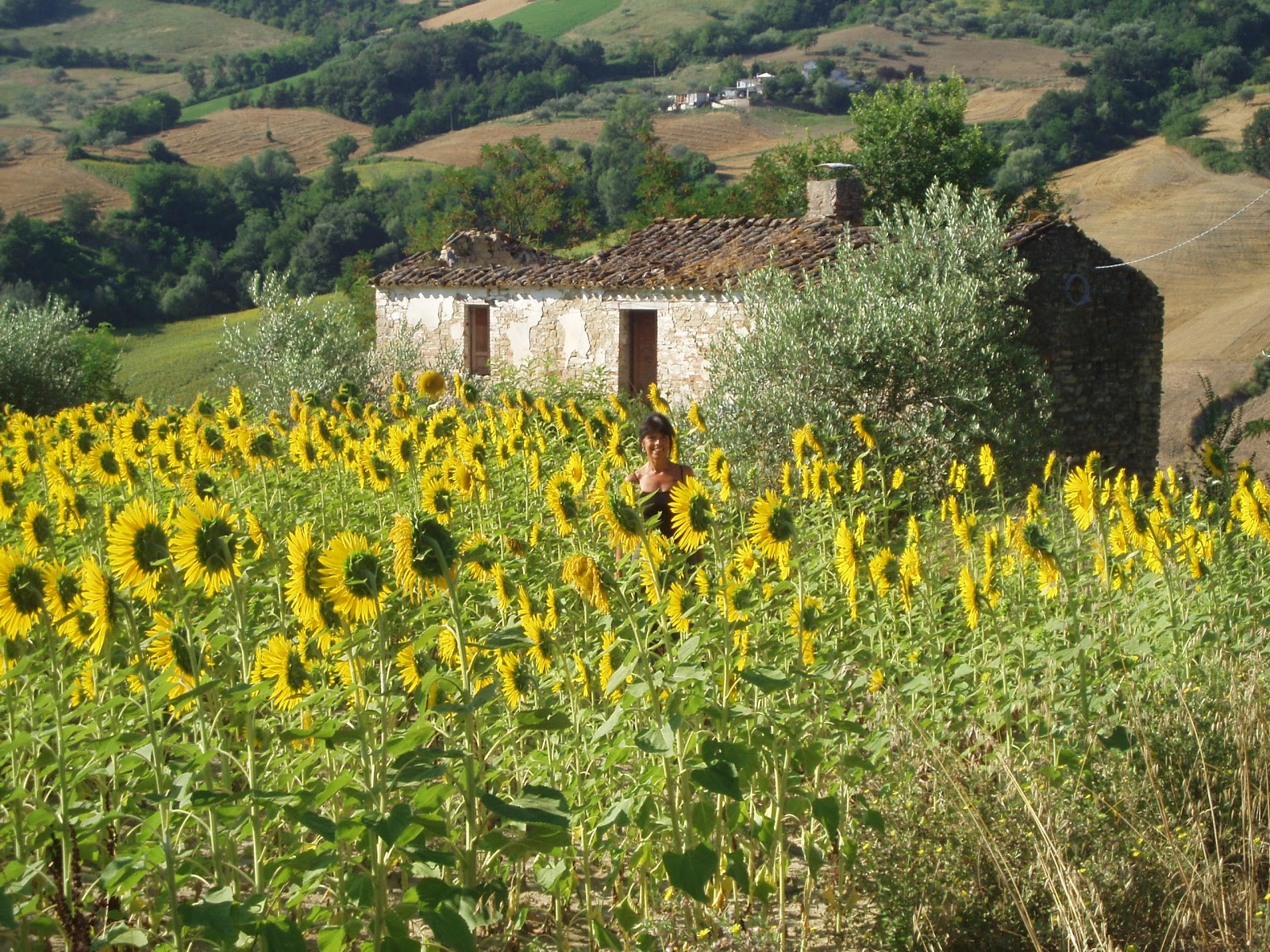
                                           Me Among Sunflowers

I smiled for the first time in half a day. The journey was just beginning.

Friday, January 13, 2012

A Simple Town

My dear little town of Castiglione Messer Raimondo.  You are a sneaky devil. But I'm wise to your wiley ways now. I see the pattern! I'm calling you out on it. I see this is how you work:
Unsuspecting travelers arrive in Rome. Not Pescara. Oh, no. That's too close. Only a 40-minute drive away. It would be too easy. Rome. Yeah, that's it. Have them arrive there after an overnight flight in which they've barely slept. Then they rent a car. At the airport office where the laconic desk clerk rolls his eyes at every question and speeds through the fine print in heavily accented English in order to not miss a millisecond of the conversation with his Italian colleague that was interrupted.  Then they exit the airport, trying to navigate the roads, the signs ("What! They're in ITALIAN!"), and the maniac drivers simultaneously. When their bleary eyes finally alight on a recognizable road number, the A25, it's buried in the following: A24/25E80Naples/L'Aquila/Rome/Pescara. Whoa! "Is that the exit?" Quick cut to the right, barely missing the Cinquecento that suddenly appeared to pass them on the right. The driver yells at the poor travelers as he tacks to the left and disappears down the straigtaway.
30 minutes later, they are out of Rome and breathing a sigh of relief.
10 minutes later, they are in massive, grey, lonesome-looking mountains with isloated towns perched precariously in the distance, miles from any obvious road. The travelers nervously keep their eyes peeled for vultures circling above them. And search for a rest stop that assures them they've not permanently left civilization. And search. And search. And search. And narrowly miss the entrance to one because they've misjusdged the distance to get there because all the signs give distances in KILOMETERS!
No matter. There's the exit - remarkably reading just as they were told it would: Pescara Nord/Citta' Sant'Angelo. Saved!
Maybe.
There are two kinds of native drivers on Italian mountain roads: those who drive very slow, and those who drive very fast. The ones that drive very fast ride the newbies' tailpipe until they zoom past them and narrowly miss the front bumper as they zip back into the lane to avoid the freight truck barelling down the mountain in the other direction. The slow drivers trap the newbies behind them, causing the fast drivers to pass both of them (or three or four other cars) at once resulting in the same scenario as above.
The entrance to Castiglione Messer Raimondo is marked by a concave mirror which allows cars negotiating the sharp turn out of the main road to see the fast drivers as they come up a blind curve. This is the traveler's landmark to turn left - a sudden, sharp left into town. 3 1/2 hours after picking up the rental car, the traveler has arrived in Castiglione Messer Raimondo. Parking and leaving a vehicle never felt so good.
By now the weary traveler is so frazzled, tired, and disoriented, that he and/or she looks around to try ground themself in THE REASON. Where is THE REASON for the trip? There is no Colloseum begging entrance, no ornate Duomo commanding a photo session, no glistening canals eliciting romantic sighs, no bustling street vendors capitalizing on the oggling crowds to sell them memories in 4 X 6 cardboard photos. There's just the Chiesa di San Donato Martiro at first, its tall rotunda topped by a giant iron cross. Its bells may ring for mass. And the traveler gets his or her first glimpse of the people of Castiglione Messer Raimondo filing up the steps: the old women with their black sweaters shuffling up sideways to save their knees, the slighlty tired looking housewives nonetheless well-dressed and coiffed, the little boys and girls in hair tamed with oil or ribbons. And that's when the sneaky magic begins. The traveler is drawn to the people. Curious. Fascinated as they recognize a fantasy of Italy recalled from images 50 years old, or
see now in front of them an exact replica of a childhood neighbor or aunt, or hear a sound that sets into motion heartstrings long dormant. And then it begins. The Castiglione witchcraft. The insidious charm that starts to permeate the travelers weary, unguarded bones.
In a few days, Teresa will have motioned one over to point out the best loaf of bread in the bread wagon. Manola will have given one the best haircut ever - for 35 euro. The bar owner will have sat one down for a complimentary beer. A shop owner will have invited one to his accordian and mandolin concert later that night. The little auntie look-alike waves enthusiastically the fourth time she passes the house on her way to mass, shouting "Tutto aposto?" (Everything in order?). And then the traveler will know why they've come. They will have recognized THE REASON. They came not to see what Italy is famous for, but to see Italy. To be Italy. To participate in the life of Italy. They will know that they have come home. Whatever their idea of home was.
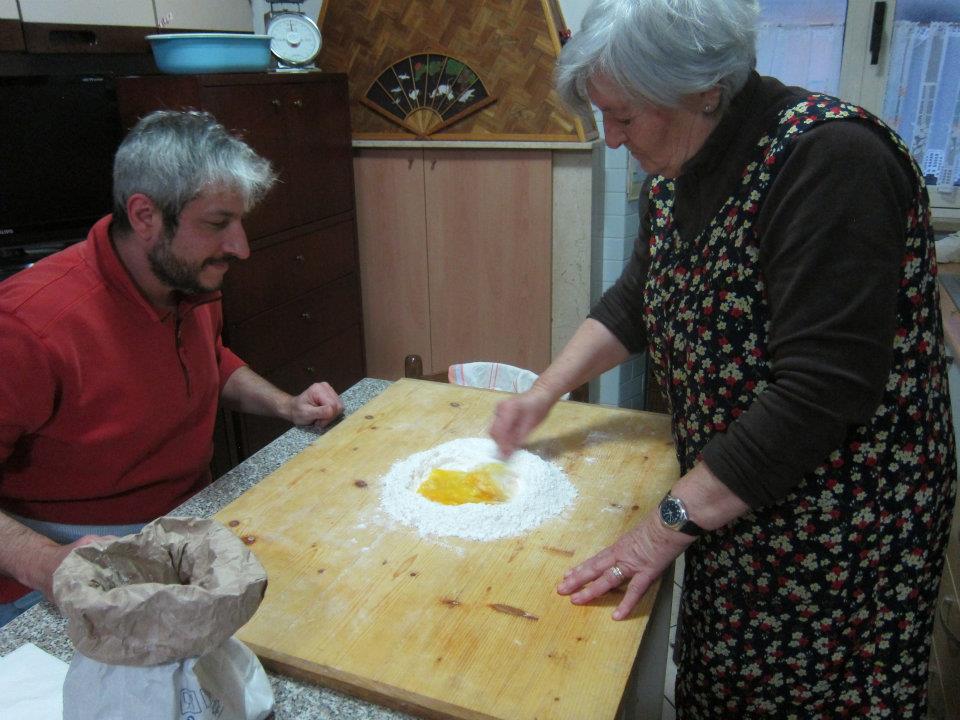
 Italian Mama teaching guest to make traditional Abruzzese pasta:
Macherroni all Ghitarra
 The "Ghitarra" for cutting the pasta
 Guest offered a sample of the ragu'
 A Guest got creative with statues at the church in front of the house

The Culprit!


 Peering at Mass goers

 Ceramic Artist

Guests celebrating their arrival

Sunday, November 20, 2011

Ciao, Berlusconi But You're Not the One and Only

Italy has been in the news a lot lately. Unfortunately, often coupled with Greece and the two countries' impact on the world's impending financial demise. So much hand-wringing on Wall Street: What to do? What to do? What to do? The money brokers were offered a brief glimmer of hope when Silvio Berlusconi resigned a week ago. They expressed themselves with more points on the NASDAQ. Never ones to be outdone in the emotional expression department, Italians in Rome and other cities jumped for joy in the streets and waved signs with various exit wishes for their former leader. I asked my Italian friends how they felt about this. Most said "Mi sento contentissimo!" [I feel very happy!]. But more than one tempered the joy with the understanding that there are still a bazillion politicians in power with the same self-centered mindset as Berlusconi. Politicians who suck up funds and bleed the resources of their country for no other purpose than to buy more villas in Sardinia, Lake Como, or the islands off the coast of Sicily. When I asked one of my friends, "How can these politicians do this?" she ramped up her passion by degrees as she shared her thoughts, emitting a shower of hot emotional sparks as she went. "They are blind!" she said, "They don't see what there is in Italy. How can they line their pockets when there are good Italian people out of work? How can they take free train and plane rides when opera houses are closing for lack of money? How can they put more and more friends and cronies on the payroll when historic landmarks are in need of repair!"
How can they (or not), indeed. How can they not see the treasure we who have not lived there all our lives have come to fall in love with? We who dream and save to see, touch, taste, smell, and experience the tantamount aspect of Italian sensibility FEEL what one travel book described "the land of your most ancient dreams".  Yes! They are our most ancient dreams because they come from our most ancient foundations: Italy's past is the bedrock of modern western civilization. Civilization that goes back beyond its contribution of the Renaissance, that gave us the locations of the Odyssy and Persephone's island. Thousands of years later the winds that blew Odysseus back to the Aeolian islands are still producing whitecaps in the Straits of Messina.  A land that gave us mysteries and miracles and a real sense of the sacred:  the supposed sighting of Michael the Archangel on the Garfano promontory inspired a pilgrimage site that, upon entering, moved both myself and my Jewish friend to tears.  Italy gave us salt from Venice, the name "Vulcano" from the ancient island where the homonymous blackmith to the gods was based, and thousands of uses for olive oil. It gave us the arch, the dome, the stadium, the acquaduct, and the race track. It gave us the Commedia dell'arte and its characters and plots for Shakespeare's inspiration. How can a culture of "bunga bunga" supplant the preservation of thousands of years of cultural contributions for anyone connected with Italy? Is there no pride left?
My friend says the lack of appreciation for what we have in Italy, and where we come from stems from "egoismo".  More than "ego", the translation rolls the toxic combination of sefishness and arrogance into one concept.
 Piazza della Signoria Florence

 Grazing in a Vineyard, Loreto Aprutino, Abruzzo

 For a few days now, I've been in a funk trying to figure out how to counter such a mindset. If so many politicians still in office have the same attitude, what will become of the beloved country of my father and grandfather? What is the antidote to the toxin "egoismo"? Just now it occured to me: Love. Simple love. I'll play matchmaker. I'll  bring those who love and appreciate what Italy has to offer together with Italy itself. One visit at a time. One summer at a time. I've already seen what appreciation of their little town does to the hearts and souls of my friends and neighbors in Castiglione Messer Raimondo. It sends them soaring. There doesn't need to be big bang of immediate political and financial change. Just a steady glow of appreciation from admirers. I'd like to think that eventually it will sweep all the egotists away into Homer's dark, Mediterranean sea. To be replaced by those who will maintain Italy's history and dignity. Who will coninue to support the selfless people I've come to know in Abruzzo and elsewhere who will run out of their houses and hand a stranger a bottle of home-made wine as you stumble along a dusty hiking trail. A gesture, to again quote the travel book "that is a million years old, far beyond courtesy, rooted in ancient communion."

Guests  Jerry and Susan at Vineyard
Ancient Alleyway in Castiglione Messer Raimondo

Saturday, October 1, 2011

Confession

Today, Saturday, October 1st, 2011, it has been about one and half months since my return from Castiglione Messer Raimondo. 46 days, 7 hours to be more exact. I said the previous post would be my last, reasoning that since I would no longer be at Casa da Carmine there would be no more material to draw from for further writing. SIGH. In some ways I wish that was true. Then perhaps there would not be such a yearning, burning, feeling inside me. I knew the re-entry into American life would be tough. But I'd get over it. I thought. Then came the earthquake, Hurricane Irene. Made life a bit interesting. Provided some distraction. These were followed by flooding, rain, and grey, grey, grey. Now the air  has turned cold to boot. The bite of fall with an aftertaste of winter in the wind. Many leaves have given up on turning color and have gone straight to brown and dry. I'm giving up, too. Giving up telling myself that I don't miss Abruzzo in general and the little guesthouse in the simple town of Castiglione, in particular, to the achingly acute degree I do.
I tried to replicate some aspects of the Italian life I'd led in CMR: I regularly stop at Amish roadside stands to buy locally grown fruit and vegetables; I prowl the aisles of Amish stores to find the best homemade bread and cheese; I cook with only extra virgin olive oil; I walk to the gym to savor the quaintness of our little town of Lititz. But it's time to confess: It ain't doin' the trick. Something huge is missing inside. I told Greg I feel like a sticky grey film has wrapped itself around my mind, my heart, my soul. And I just can't figure out why. I can't figure out what it is that is missing.
Yesterday I sat with Olga, my friend from Naples and Italian teacher. We were commiserating over our yearning for Italy as only those who have the same malaise can.
"What is it?" I said. "I have a good life. I love my work here. I have a great group of students this semester. I love having such easy access to my children. I'm so happy to be able to hug Greg every day. What's the deal?"
She gestured to the large picture window in her kitchen.
"Look outside", she said.
I did. I saw neat, green, similarly ordered, rectangular lawns. They encirlced pristine townhouses whose paint was uniformly lacking in scratches, peeling, or chipping. Flower pots sat perfectly coiffed in their blooms. Late make cars shone in what little light the late afternoon held. We stood and gazed for several seconds. In absolute silence. There was not a soul out and about to acessorize any of it.
"Where is the life?" Olga asked. "Where is the source of life? Where are the people connecting to each other and to life?"
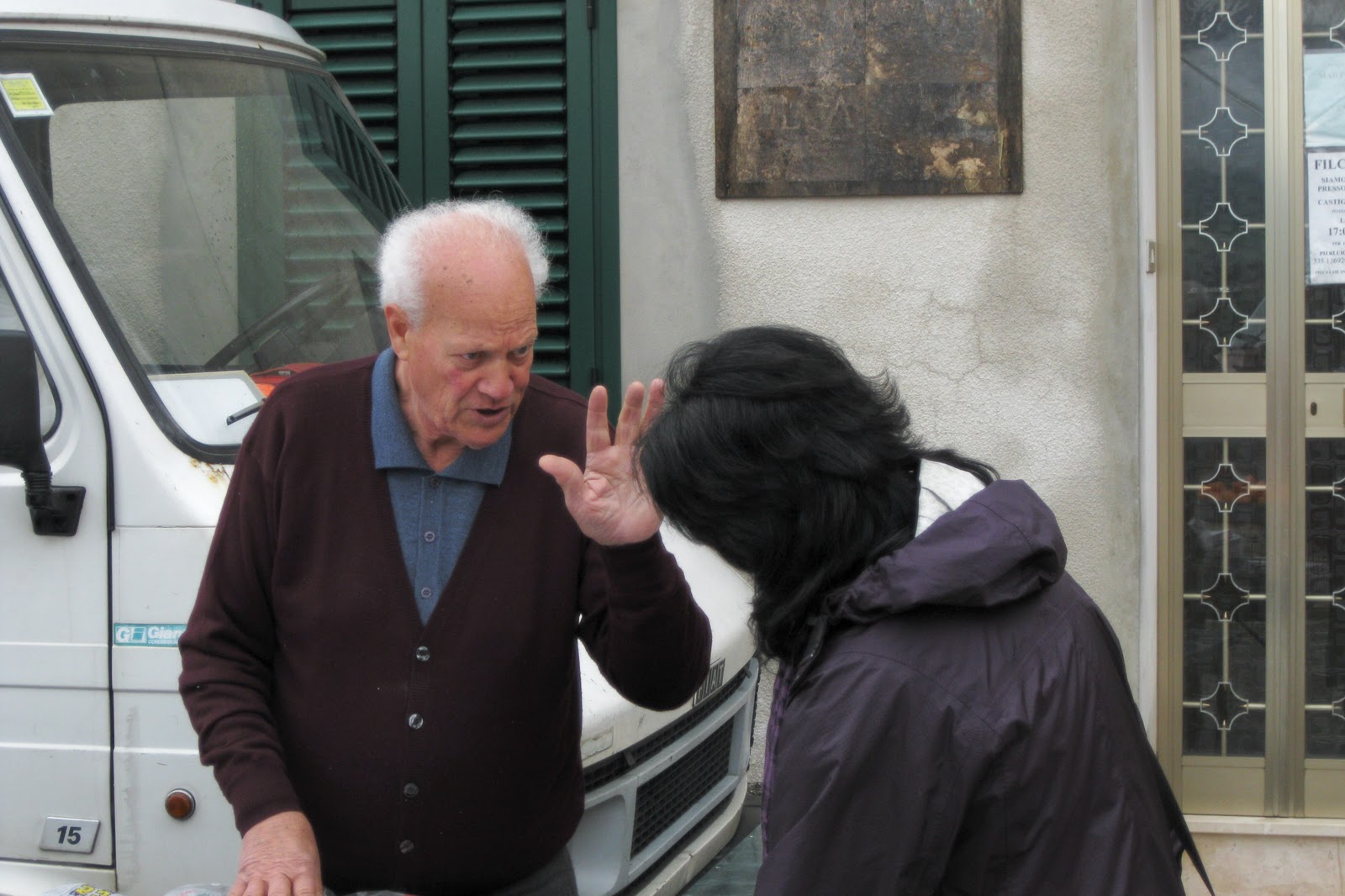
Haggling at the Saturday Market

Singer at Montefino Music Festival

Me and Teresa of Cinotto fame!

Dog Guarding Sheep on the Way to
Campo  Imperatore
My friend Vincenzo took a Sunday off so I could see the mountains up close.

Friend Camillo showing me Pontius Pilates' birthplace

Readying Myself for the Giro d'Italia!

That's when I was aware of what ails me: What I miss is something I, or any person, cannot create here -
the aggregation of human spirit. Expressed in daily, ongoing social interaction. It happens spontaneously, joyously, boistrously, chaotically. With this realization, the sensation of all I missed came surging into me: the sight of women filing past my window on their way to mass, the honey richness of their voices thickening the air; the mass of children chasing each other in the bellevedere, chins drippping with remnants of stracciatella, ciocolatta, fior di latte, or bacci gelatto, their parents standing, strolling, or strutting near them, gesturing, laughing and puncturing sentences with the ratta-tat-tat of Italian excamations, the smell of slightly burnt pizza dough floating up from the pizzeria behind the house, Pasquale ringing the doorbell to warn me "La macchina e' aperta! (my car windows are open), the bread man beeping as he bops through the narrow streets in his van on Monday, Wednesday, or Friday, the light drenching the Gran Sasso mountains with contour and shadows that make them seem oh, so very THERE! The unapolgetic cling of fabric to the male and female form. And the bells. Yes, even the bells of the Santuario di San Donato, that used to worry me to death because they'd ring every 15 minutes, 24 hours a day and make me think "Dear God, how will guests ever survive here!" They ring only for mass these days, first in a pattern that warns of the impending event, then in a torrent of random pealing that tumbles from the campanile and explodes out over the town. The bells. My morning wake-up call. To all that the new day in Castiglione holds. All its promise and surprises and frustrations and beauty. And all the life of its people spilling out around me to see, to share, to taste, to hold, to touch, to smell, to lose myself in until I tumble into bed lulled by the swoosh of breezes over the valley and the occaisional mewling cat. It is this river of life that feeds my soul that I so sorely miss. With each passing day, the level of life force it has given me dips a bit lower. My being droops a bit more.
I've just accepted the first guests' booking for summer, 2012. Return is imminent. Only about 230 days left to go. I'll keep you posted on how they go.
"Viccolo" or little alley in the town of Castiglione


Arrivederci!

Monday, August 22, 2011

Uncinetto and the Unskilled Hands


 Meet Teresa. You can't see her face clearly here. She's beautiful. I couldn't upload the photo of us standing together in the square outside my house. Not skilled. Very fitting. Teresa taught me quite a lesson in skill and patience.
Teresa is one of the first people I met in Castiglione. She is 80-something and was a tenant in my house for the first few months I owned it. As I toured it for the first time, she sidled up to me and said "If you need someone to clean it, hire me. I'm good." It was less a request than an order, said with such aplomb I'd have agreed on the spot if I could have overcome the guilt of putting what felt like my own grandmother into servitude.
Teresa doesn't hear well, but her shining steely eyes miss nothing. Her voice is an unmistakable trumpet (albeit one played by Louis Armstrong) that heralds her presence everywhere. Like other older women of the town, she walks uphill to church every day and wears a photo of her dead husband on a delicate gold chain around her neck. Right from the start we delighted in the fact that our names are the same and our families are both from further south -- mine from Campania; hers from Calabria. I fell instantly in love with her.
Like many people of Castiglione MR, she invited me to visit. I took her up on it. Several times. Once, while sitting in front of the TV, a healthy fire she had made herself warming the sitting room, she railed against Berlusconi's image. I noticed it made her fingers fly faster through the work she was doing. She was making a coverlet for  a new baby.
The work is called "uncinetto" she told me: tiny, delicate crochet stitches  that add up to doilies, blankets, hats, baby shoes, even an intricate rosary. I watched her needle dart in and out of nearly imperceptible holes, combining to magically weave flower or bird designs into the work. I knew I had to learn this craft.
So, on my next visit, I bounced through Teresa's door with a bag containing two balls of thin white thread and a crochet hook whose end I could barely see.
"Will you teach me?" I asked.
Teresa instantly stopped, looked at me as though I'd just proposed going to the moon, then threw her head back into her signature laugh that is both cackle and girlish giggle. Then the lesson began.
Teresa made a chain. Wrap and pull. Wrap and pull. When it was about 4 inches long, she handed it to me.
"Come back when you have this much." Her hands were spread to about a foot apart - another 8 inches for me to create.
At home, I tried to replicate her moves and rhythm. Wrap and pull. Wrap and pull. Easy. I remembered this from my crochet and macrame' hippie days. The problem was the tension. My chain wasn't lacy and consistent like hers. Some rows were big, loose, loops, and others tight knots. 
Italians have a saying "Fare e disfare e' l'arte d'imparare" (To do and undo is the art of learning.) Ho fatto io quest' arte tantissimo! I did a lot of the art of doing and undoing. Moreso than I was able to DO the actual art of uncinetto.
After two days, I had my chain. Ran down the hill to Teresa's house, pleased as punch to know I'd be initiated into phase two of "fare".
Slogged back up to my house two hours later. Phase two consisted of inserting the hook through holes invisible to my eye, wrapping the thread several times around it, and pulling the enlarged mass back through several microscopic openings.


 I fumbled. Lost the thread. Got the hook stuck halfway through the holes. Dropped everything on the floor several times. My hand position was wrong, fingers ill positioned. Teresa took them and bent them into place, putting the work into the proper position relative to hands and fingers. OW! I felt like I was being tutored by a master prestidigitator: one finger here, another several awkward inches away, knuckles up, knuckles down, one digit moving in opposition to another, wrists tilted at a strange angle. After 45 minutes of contorting my hands, Teresa took the uncinetto into her own, 80-ish, arthritic ones.
"Faccio io. E poi, lo provi. Guarda!"
[I'll do it and then you try. Watch!]
Then her fingers were off to the races. Even my brain couldn't keep up. Did she do two stitches or five before inserting the needle? How did she make the little chain that links the rows at even intervals to form the lovely windowpane pattern characteristic of uncinetto? But most of all, how the hell did she see??? Row after row formed in a flash, then woosh, she handed the work to me.
"Prova!" she said, grinning. [Try]

I did. Marveling at my clumsiness as Teresa side-coached.
"Stringi!" [Pull!]
"Troppo lento!" [Too loose.]
"Troppo stretto!" [Too tight!]
"Giri. Tiri.  Metti in bucca." [Turn. Pull. Put in the hole.]
Every three attempts, she would shoo my hands aside and pull out the stitches. Disfare. [Undo] Nooooooo!
Fare. [Do]
Giro. Tiro. Metto in bucca. [I turn. I pull. I put in the hole.]
Fare.
Disfare.
Fare.
Disfare.
Over an hour later I heaved a huge sigh. The work hadn't progressed one iota!
Teresa eyed me with a mix of curiosity, incredulity, and concern.
"Sei stanca? she asked. [Are you tired?]
Body, no, I explained. Brain, yes.
"Allora. Fai una pausa. Lo provi alla casa tranquilamente. E poi torni domani o doppodomani. Vedro' il tuo lavoro e continuiamo. Cafe?" [Allora (my favorite Italian word, which has no literal translation, but begins just about every Italian's sentence. Something like "Okay, then..."). Take a break. Try it at home. I'll look at your work and then we'll continue. Coffee?]
I accepted it gratefully. Along with biscotti and fruit.
For three days now I've been struggling to duplicate Teresa's handiwork. My hands have gone numb. My wrists ache. The slender thread is so kinked from repeatedly "disfar- ing" that the work sproings all over when I try to add to it and keeps jerking out of my hands every 5 seconds. I've been near to tears several times.
"What the heck!" I think. "This is little old lady stuff! How hard can it be?"
But it is. My hands do not want to stay in position, the needle gets stuck in the tiny holes or slips out just as I've gotten it through after 30 attempts, my sweaty hands are turning the pristine white thread gray, and my eyes are so squinted up they've nearly disappeared into my head. I set aside the needle, ball of thread, and tiny patch of work. This is stupid. I'm not cut cut out for this. How presumptuous! This is a tradition learned over decades. Teresa said she began when her 40+ year old sons were babies (oh, yeah, how do you have time to focus on this stuff with BABIES!). Clearly I am made of lesser cloth. I'm kidding myself, a wanna-be Abruzzese Nonna in training. I put the work back in the bag.
Two days later, I pick it up. I saw the owner of the local stationary store sitting outside the shop door needling away. When I remarked how difficult the craft is, she smiled and shook her head.
"No, no! E' facile. Ma ci vuole tempo. Piano, piano." [No- it's easy. But it takes time. Slowly, slowly]
Piano, piano. Those are words I've heard repeatedly here. In response to everything from work I said I wanted to do on the house to having my family come visit, to being served continuous waves of food. Piano, piano. I'm not a piano, piano kind of gal. More like a get-it-done-Mario-Andretti-style type. This will be a good lesson for me. I resume the work. Piano, piano. Even though I forget how many stitiches Teresa told me to chain each time. Piano, piano. Even thought the rows' lengths are all uneven. Piano, piano. Even though my window panes are large, loose, loopy arcs compared to Teresa's tight rectangles.
Three days later, I've done enough fare e disfare to show her. She studies the piece.
"Non e' male", she says. [Not bad] I grin.
Then she pulls everything -- EVERYTHING -- out! I have to restrain a little bleat of pain.
But now Teresa really gets to work.

She orders me to sit right up next to her. Watch. Count. Pass the needle. Loosen. Tighten. A row forms in a flash. turn In. Out. 2X. Loop. Through 3 loops. Thread over index finger, work beneath. Stretch the completed part in your right hand between the middle finger and thumb.
"Guarda! Guarda! Cosi'!" [Watch! Watch! Like this!]
Then it's my turn. Uncross your legs, she barks. You need room! Stringi! Pull! No-no! Troppo! Too much! Ecco. There. Uno. Due. E passa. One, two, and pass through. We do and undo. I work piano, piano. After an hour, out of about 30 window panes, I have successfully completed 5. She points to each one. She smiles. "Brava!" she says. I float home.
Over the next few days I work piano piano on several rows. They're still not as neat as Teresa's, but they are becoming more similar. I take her a large piece of completed work. She nods approval. Work until this is easy, she says. Then I'll show you how to make designs. I tell her I can't wait! I'm leaving soon. I'll have 9 whole months of fare and disfare.
I stopped by Teresa's house this morning for an "arrivederci" before departing for the US. "Alla prossima", I say [Until next time]
"E l'uncinetto?", she asks.
"I'm working on it piano piano", I reply. "Maybe when I return I'll be as good as you!"
She laughs her girlish cackle as we hug. As we step apart, I realize both sets of eyes are glistening.
Teresa's work

Teresa's work

My work!

Monday, August 1, 2011

No foto!

Alas, gentle reader. there are no photos available for this post. You will have to turn inward and use your imaginations to see images of this extraordinary house in Penne, a town just 25 minutes from Casa da Carmine.
There could have been photos. One of my current guests is a photographer. She teaches is at Penn Manor High School. She has a fancy-scmanzy camera and has taken at least 700 outstanding photos since her arrival in Abruzzo on July 18. Her camera was slung around her shoulder when we entered the home. But Ken, one of the owners said, "We wanted a monastery. I couldn't find one, so this will have to do."  As monitors inside many of Italy's chief religious halls, such as the Sistine Chapel, caution, out of deference to this hallowed space, there was No Foto! So reader, you will have to, for the most part, make your own pictures.
Picture this:
Seven people gather at the outdoor dining area of  Giumpy's, a restaurant in Penne accessed via a steep, cobblestoned incline. The view over the city is, of course, breathtaking. The sun is beginning to set and in the midst of houses silhouetted by shadows cast in its wake, one bright, yellow structure is illuminated. It is as if something holy is being highlighted. We seven turn to comment on this sight, when, from behind us, spirited voices adorned with refined British accents capture our attention. I turn. Entering into our midst is a stately man resembling a thinner and fitter Winston Churchill, and his partner, Ken. Our own Winston Churchill, John, is fascinating enough, his gentle yet stern voice admonishing the Cairn Terrier he has on a leash to leave off trying to attack a cat. But Ken...Ken is riveting.
Picture this:
He is dressed all in white: linen suit, silk shirt open to reveal a perfectly tanned chest discreetly adorned with a gold cross on a chain, a triangle of white handkerchief poking out of his jacket pocket, shoulder-length grey-white hair, and ice-blue eyes that nonetheless sparkle with warmth and life. He claps those eyes on you, and you cannot turn away. He is a ringer for Peter O'Toole in "The Ruling Class". As he launches into a lively explanation of the origin of the name of the Cairn Terrier breed, I am suddenly at Westminster with an urgent need for this information. When we finally are seated for dinner, not surprisingly, he is at the head of one end of the table; John is at the other.
Ken is an artist. John an engineer.  They are friends of Gerry and Shirley, two friends from Penne who invited me and my houseguests to dinner. John and Ken are from London. They have lived and adventured together for nearly 50 years, two of them in their house in Penne. Ken is a mural painter. He gained notoriety years ago when he was sought out  to decorate Harrod's department store in London. He has been an honored guest on the QE2, where he was forced to exit the ship through the galley to avoid hoards of admirers and reporters who would not have let him pass without waylaying him to seek his attention.
Dinner is peppered with wine, accounts of their travels, their move from their house in the south of France to Italy, and lots of laughter in which Ken's blue eyes ignite and infect us all. Afterwards, we are invited to their house for digestivi.
Picture this:
The entrance door is a high wooden arch, at least 30 feet in length and broad as a cathedral door. It opens into a courtyard, exposed to the night sky, in which a fountain gurgles a gentle welcome.
I'd ordered a pizza for dinner, which I only half consumed. It is clutched to my chest in an indecorous cardboard box. Ken invites me to leave it on the white iron table sitting next to the fountain. It seems sacreligious to do so, so I freeze in place. Ken gently takes the box from me and casually plunks it on the table.
"Come in", he says, sweeping a thin arm in the direction of an open arch beyond the table. "I'm somewhat of a Jesus freak, you see. I wanted a monastery, so I'm making one." And there's the sparkling laugh that again lights up the eyes. So I move in the direction of the line of his arm.
Picture this:
The room extends upward to a vaulted ceiling which could easily be the nave of a church. The first sketch that catches one's eye is a floor-to-tip of vault rendering of the holy ghost with an olive branch. Next to it stands a full-color replication of one-third of a triptich of the Virgin Mary, replete with blue robe trimmed in gold. "This one was ordered by the King of Malta, you see", Ken says completely devoid of braggadoccio. "It's my own style, but it follows the rules of what the icon must have. You see - the three folds on her right shoulder? Without those, it would not be a true icon." And he proceeds to explain the other details needed in order to capture true icon status. "We can do them in our own style, you see. But they must contain the requisites." I'm awed and fixated.
Picture this:
On the far wall of this room, there is scaffolding set up, Michelangelo style, for Ken's current work: Another huge mural that covers the surface wall-to-wall and floor-to-ceiling. It is the Sacred Heart of Jesus. His eyes are drawn so that no matter where you move, they follow you. You are held in the holy time and space of that gaze no matter where you go. Studies and sketches for this mural are strewn throughout the room. Paintings of more icons rest against every surface. He brushes them aside when asked about them. "Just some small things." He is more interested in throwing open the shuttered doors that lead out to the balcony. John steps in. "Oh, these clouds! If it were clear we could see the Gran Sasso. And on pristine days, you can see almost to Rome. 150 miles." "Miles?" I think. But then Ken is beside me independently corroborating the fact.
Picture this:
We are now invited into the sitting room. Above one long, suede couch is a giant mirror in a gold frame. Giant as in, Harrod's probably has store windows smaller than this. "That's an interesting frame", says Gerry. "Tell us about it."
"Oh", John says, "It looks carved, but it's not you know. It's hand-molded plaster painted with gold leaf. It's the only one in existence, really. We brought it from the house in France." He laughs. "If we get into a bind in our old age, we could sell it. It might keep us going a bit."
Ken enters the room. "Is this all your work?" Kim, my photographer guest, asks. "Yes", he replies, and smiles a childish, self-pleased grin, as if we have just pointed out drawings tacked with a magnet to a refrigerator door.
Picture this:
As I am gawking at the mirror and the chandelier above it, my eyes alight on a painting on a small wall next to the door leading out of the sitting room. It is tucked almost in a corner. It does not look like Ken's work, but the style is familiar. "Who is the artist?" I venture to inquire. John's voice is like a clap of thunder:
"Caravaggio."
                                                Not the Caravaggio in Ken and John's house, but close

Kim and I freeze, not daring to make eye contact or ask the obvious: "An ORIGINAL Caravaggio????"
But it becomes clear that this is exactly what it is. John recounts the story of contacting an art expert, an American, about the fact that he has this painting, a boy eating fruit against a very, very dark background. It seems this "expert" had not known of the existence of this painting and neglected to include it in his definitive book on Caravaggio. John's email to him, informing him of its existence was met with a reply the equivalent of "If you say so." Again John laughs. "If it's not authenticated it could be worth a half million pounds. If it is..." He shrugs. "Several million. Oh, but I'd sell the mirror before I would part with that, even if we're way too old and dottering to take care of ourselves."
Picture this:
Kim and I transfixed, eyes darting from Caravaggio, to mirror, to ivory carving in yet another gilt frame, to a five-foot high sculpture of a horse's head that looks like it was taken from Picasso's "Guernica", back to the Caravaggio. We are so silent it's like we're at a solemn mass. Ken's monastery. It's here.
Kim's camera hangs limp at her side. She cannot bring herself to use it. No foto!