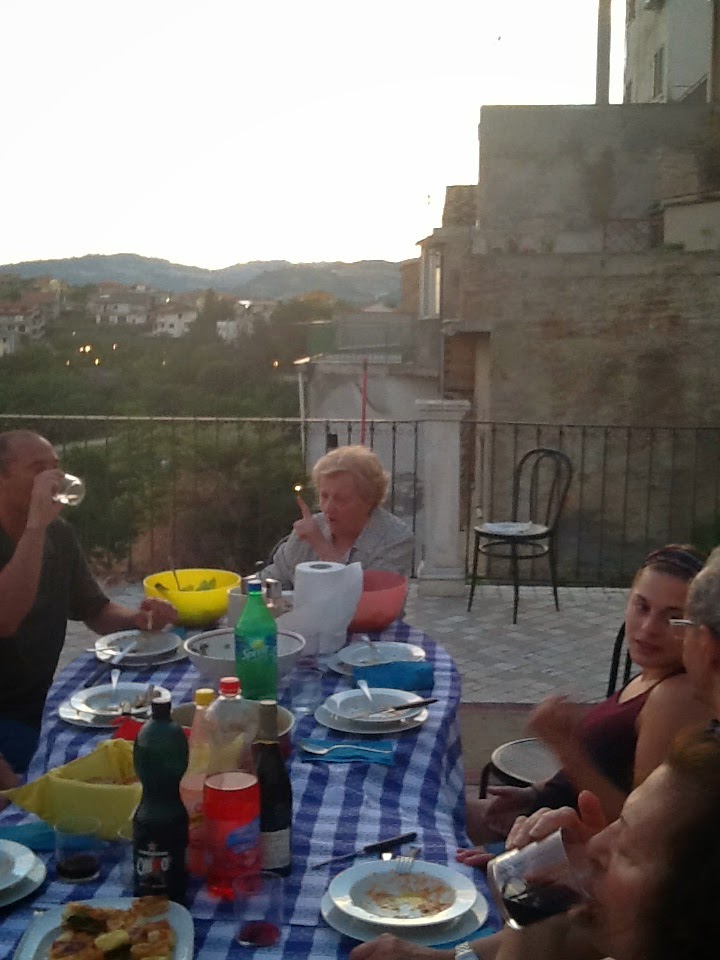
Thursday, July 31, 2014

Good People

A Grrek woman I knew and loved as much for her unabashed opinions as for the unabashed sass with which she expressed them would listen politely when people would talk of their travels outside the US. Every once in a while she would murmur "oh, yah" with what seemed like enthusiasm. When the erstwhile traveler left her presence, though, she would plant herself in her rightful kitchen chair, throw her arms arms across her chest, raise her nose so she could sway her chin side to side and proclaim "What a show-off!" There were many of these offenders, and I suppose,were she alive, I would now be added to the list. I accept the moniker and readers, be forewarned, I am now going to show off.
Within days of my arrival in Abruzzo in general and this area of it in particular, there occurs an attitude adjustment of such magnitude that I become a different person. It comes inadvertently from the people here. I visit my favorite ceramics shop in Bisenti. The shop owner, Patrizia, and I hug, genuinely happy to see each other.
     "La familia, sta bene?" "Your family is well? "
      "Si, si!" I say, and she beams, even though she has never met my family. "E la tua? Tue figlie stanno crescendo, vero? " "Your girls are growing, right?"  I have met her daughters and they are beautiful.
       "Si, si! Anche la piccola!" "Yes, yes, even the youngest!"
        I can't wait to see her. I can't imagine her growing. She has been the tiny one ever since I met her four years ago.
        I pick out a spoon rest to replace one I broke last summer. It depicts a country scene in sepia, green, and yellow with an old stone farmhouse near a creek. The scene is alive with detail. Her husband, Camillo's specialty, I know. I also pick out a card of hand-made paper. I need to send a thank-you note. She looks at the price on the spoon rest ans shrugs.
       "Veinte euro." 20 instead of the 24 euro on the price tag. The card she slides back to me.    
        "Nineteen. Un regalo." "Nothing. A gift." 

          The next day guests drive me to see a new pasticeria they have found in nearby Castilenti. Tony, one of them, is a passionate foodie and is excited to have discovered this treasure. As soon as we enter, the woman behind the counter recognizes him.
        "Bon di! " she greets him, local dialect for "buon giorno". Her wattage increases exponentially as she and Tony continue chatting in the dialect, which neither his wife nor I can understand. After a particularly bright word punctuation, the bakery woman zips behind the counter and pops back around with rotund sugared doughnuts, each about the size of a golf ball.  We must each tek one. Tony and Mary decline, so the woman hands all three to me, beaming with expectation. So even though I never, and I mean never for as long as I can remember, eat doughnuts, I politely take one and bite into it. It is the best piece of pastry I have ever eaten! Light, mildly sweet, even with the sugar, and filled with real, creamy smooth egg custard. My eyes bug out and a smile explodes on my
face. The woman claps her hands and proceeds to fill a lunch bag sized sack full of these and other
pastries. All the while the three of us are waving our hands and crying, "No, no, no, no!".  To no
avail. The woman rolls down the top of the bag and thrusts it at us.
      "Mangia domani, doppo domani. Non e' molto! " "Eat tomorrow, or the day after. It's not much."

The rounds in the middle tray are known as "bomba" : bombs. You certainly could eat enough of them to explode!


       The town's butcher, Donato, does likewise with sausages. Plus he buys us all coffee.
Donato the butcher. 


       These could, by our skeptical American minds, be dismissed as a uniquely Italian form of
product promotion. The equivalent of free samples in the local grocery store. But wait - there's. Ore to show off.
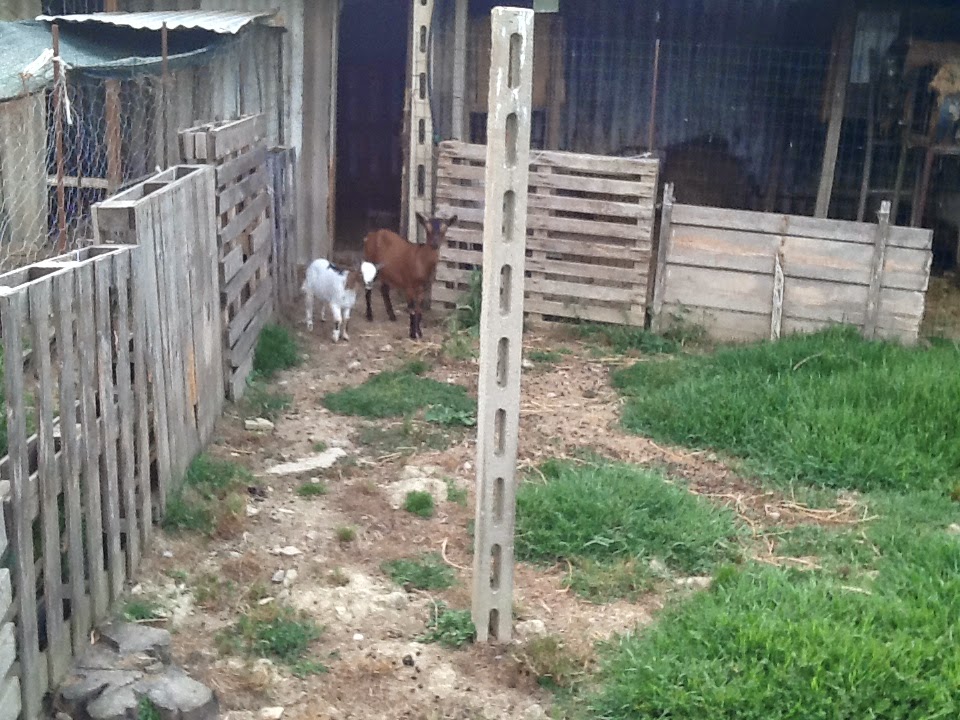
       Twice I have been invited for dinner to the home of Giovanna, the woman who cleans my house. Mine is not the only one she cleans. She works for several other people. She cleans, cares for a bed-ridden elderly lady, and baby-sits three small children. Carlo, her husband, works in a nearby factory that makes bathroom fixtures. When we arrive each time, he gives us the grand tour of their farm - the impossibly tidy rows of chicken wire, straight and even that house his ducks, geese, hens, roosters, and goats. In back of them is a long, low barn with pigeon pens, rabbit hutches, and a stall for this year's suckling pig. He walks us through the vegetable garden, past his fig trees, over to the
vineyard, and points out the hillside with their 150 olive trees. The equipment for caring for all of this agriculture is stored in an open set of bays under a corrugated tin roof supported by massive concrete
and rebar pillars. All of this he maintains himself. While working full time.


Carlo firing up the grill for arrosticini. Yes, with a blow torch. 


When he had stalled us enough so that Giovanna can complete her tasks in the kitchen, he ushers us into the house. We eat. Frittelli (a fried dough kind of bread), antipasto of prosciutto, capitols, and pancetta made from last
year's pig, pappardelle pasta, two additional meats for "il secondo", not pepper condiments made from those grown in their garden, homemade wine, salad with their exquisite olive oil, strawberries and fresh whipped cream, limoncello, crema limone, and chocolate liquor. My house gift to them of a box of chocolates from the gourmet chocolate shop in town seems blatantly paltry. When we are all able to breathe again; when I am sure I can drive up/down the one-lane road that winds from their house to mine, we take our leave, expressing thanks with words that cannot hold them. We make our way to the car gingerly, so we don't drop the eggs, meat, lemons, wine, fritelli, and preserved peppers sotto olio that Giovanna has insisted we take home. She also insists we come again.
      At home, it is all I can do to flop on my bed, worn out from feasting. Giovanna has piles of dishes to wash, food to put away, napkins and tablecloths to launder. And work to go to early in the morning. But as we left, as she shooed us away from helping her with any clean-up, she told us how
happy she was to have us,
      "E' stato un piacere!" "It was a pleasure!"  "Voi siete familia!  Tu e  Mary siete come sorelle", she finished as her eyes shine. "You are all family! You and Mary are like sisters!"
        On my bed, my head spinning like Dorothy's after the tornado-instigated bonk on the head, I know I am not in Kansas any more. Or anywhere else in the States. I am in a land where sharing, opening one's heart to others is so much the norm it is unthinkable to do otherwise. Generosity, the joy of sharing, the pleasure of opening one's home and being to others is innate. Crack. I hear the sound of an American attitude adjusting.

Thursday, July 24, 2014

I Am the Egg (wo) Man

I outfitted myself for a morning run. Well, okay, more like a combination run/walk/slog. It was still 3 days before the Bearman was due to arrive and usher in three weeks of hiking and sea kayaking. I needed the dusty hills of the country road leading out of town to get my cardio system ready. Curling uphill, downhill, past olive groves slanting downwards from undulating hills, the road changes from macadam to gravel before reaching my turn around near a football field sized tomato patch. The final uphill slog into town comes a half hour after this. Even though I had been running every other day for the past 6 weeks, I felt unprepared. I was planning to tackle the Corno Grande this summer, after all - at nearly 3,000 meters the highest peak in the Appenines. And very rocky. And steep. So it was time to get moving. Everything was in check - cell phone in pocket in case the nasty dogs nastied at me, frozen water bottle thawed just enough for the sippy thing to pop up, sunglasses - oops! In ran upstairs to retrieve them. When I ran back down, there she was. She stood well inside the front door. In her hand she held a bulging plastic bag. I didn't recognize her, although she dressed like all the other older ladies in town - black, shin-length dress with a discreet floral print, square-toed shoes that provided a sturdy platform for her swollen ankles, grey hair cropped just short enough to reveal gold rosettes on her earlobes, and the obligatory gold cross at her neck.
      "Do you need some eggs?" she asked, holding up the plastic bag. It looked half full. I did, in fact, need some.
      "Six euro for the whole bag."
      "Oh, no,no,no", I said. "I don't need that many. I'll just take a few. Maybe four or so."
       The woman continued as if she hadn't heard me. Or maybe my Italian was too bad to understand.
       "Three euro a dozen. But the whole bag for six euro. And I'll give you six for free. A gift."
        I shook my head. "No, thank you. That's too many. I'm here all by myself"
        The woman wobbled further inside and peered around. She tapped on the door to the downstairs kitchen.
        "Isn't there another family here?"
        "Yes, for now, " I said."but they are guests. They don't live here all the time. I'm here alone. I
         can't eat all those eggs."
         "She shrugged. "Put them in the refrigerator"
         I tried to speak, but didn't have the words I needed with which to counter her.
         I stammered. "But, I still won't be able to eat so many eggs. It will take me a long time. They'll go bad before I can eat them all."
         "Six euro," she insisted. "And six eggs as a gift."
          "What if I buy six eggs? How much?"
            Egg Woman opened her arms wide, palms upturned, and fixed her eyes on mine.
           "No! No! It is such a good bargain! Six euro. The whole bag. Six eggs I give you as a gift!"
            The sun was rising in the sky. I less than an hour it would be straight above, broiling the road and me on the last leg of my run. The frozen water bottle was weeping on the desktop.
           "My Italian is not so good," I said. "So tell me - you are saying I can buy the whole bag of eggs for six euro?"
           Egg Woman nodded.
           "Okay. But I don't have six euro exactly."
            "Give me a ten. I'll make change." She held the bag out to me and shook it just enough so it could whisper in collusion. She smiled.
             I ran upstairs, got a 10 euro note, and gave it to her. She gave me change in 50 and 20 centessimi coins.
            I then placed 32 eggs in the crisper drawer of the refrigerator.  As I ran I though about my attempt to resist the Egg Woman. It occurred to me that climbing the Corno Grande might be the easier task.
I am your Egg (wo) Man . You will obey. 


Saturday, June 14, 2014

Trivial Thoughts

Morning. Coffee on the terrazzo. Sitting and watching a thunder boomer, un "temporale" play out over the silhouette of Citta' Sant' Angelo. I think trivial thoughts like "I hope it blows over; this is a designated beach day." And "Is it headed this way; I wonder if I should water the plants?"  I used to find these kinds of thoughts shallow. I used to be ashamed of them. After all, there are wars, gun violence, rape culture, starving children, aids, Alzheimer's, and illnesses occurring at the same time these thoughts arise. But now, I admit, I find the trivial thoughts a relief. A break from all the chatter exhorting me to save the world. A release from the Facebook memes and the petition signing requests and pleas for a $50 or whatever-you-can-give-we-are-grateful-for which will make a difference between us and the baddies winning on any issue.
Man, that thunder just keeps rolling along!
Whoa! Three streaks of lightening flashed in perfectly timed sequence, as if they were illuminating a Rolling Stones concert on the other side of the hills.
Whoa! Now the Stones have moved north towards Montefino and are really kicking up the light
show!
But the woman from the pasta shop, in her pink smock and white triangular scarf leans against the bellevedere railing having a slow smoke. There goes Fernando down the stairs to the parking lot. He pauses briefly after a loud boom, looks up, and continues down without changing his pace. Here comes Donatella's voice, always full of laughter, even when she is just speaking. It's mingled with the men's voices jabbing the humid air more and more sharply as their excitability grows. A dog runs across the main road. He slows to a stroll once he is out of the traffic flow and licks himself.  This is the way of a localized way of living. Life in the here and now. With the people next to us who we can see and touch. Whose lives we observe or in which we are involved first hand. Whose presence (or lack of it) is felt (or missed) daily in the vegetables, fish, bread, clean laundry, clothing, smiles, and conversations they provide. Whose impact is felt first hand when they are gone. That storm? It's on the other side of the world.
I think I will water the plants. And let the light show roll on.


Tuesday, June 10, 2014

The Queen of CMR

"Once upon a time..." That's how fairy tales begin. That's how this one begins, too. Although as far as I know there were no fairies or magic involved. Once upon a time....a palace was built. In the 1400's. When the hamlet that would eventually be ruled by Raimondo Caldara and named "Castiglione Messer Raimondo"  was emerging from its feudal state. There was still a vestige of feudalism when the palace was built, a landed gentry system. Wealthy families who owned hectares of land grew what was needed for the village to survive. They owned the space where artisans and craftspeople made the scythes, dishes, cloth, and where they ground grain. Where the miller's wife,  the mugniaia, made the region's signature pasta which would bear her name. Those who didn't own land were employees of those who did. Kind of like corporations today, only rustic. There were several landed gentry families and at least 4 of their palazzi survive in Castiglione Messer Raimondo. Gilda lives in one of them.
She wasn't born there. Nor did she begin her life there.
She began her life on a rotating board placed in a small, arched opening of a convent. Kind of like a lazy Susan for unwanted babies. The nuns took her in. No one has told me how long she was there before being taken in by the padrone of the grand palazzo. Its vaulted ceilings in the entrance hall and in each room are decorated with frescoes. The terrazzo at the far end of the hall has an unrestricted view of the Gran Sasso mountains. The surface of its travertine floor is easily twice that
of my daughter's Brooklyn apartment.


"C' e' una grande cantina sotto" she tells me as she guides me through the fraction of the 30 rooms that make up the palazzo. She points to the floor below as if I can see through it to the big cellar she is describing.
 "Una volta c' era una festa per piu' di 300 persone!" 
My eyes widen. "A party for 300 people down there?!" 
"PIU ' di 300!" MORE than 300! She exclaims, throwing her arms in the air. 
"Wow." is all I can manage, unable to find an Italian equivilent.
Gilda now throws her arms around me. "Brava! Capisci bene l'italiano! E' parli bene!" 
Her compliments about my language competence seem to magically make it a fact.
No one knows how long Gilda has lived in the palazzo. No one knows or will tell her age. Perhaps per Gilda's orders. But she will tell you she was quite young when she began working in the house, cooking, serving, doted on by the padrone until his death. His will stipulated that if his children did not wish to keep and live in the house that it should go to her. They didn't and it did. 
Watching her move about her kitchen, directing us dinner guests who have offered to help her prepare the pasta fagioli, deep fried green olives, and quiche-like appetizer stuffed with spinach and ground meat, it seems as though Gilda is simultaneously servant and queen. Her movements are quick, direct, accurate as she drains the pasta, stirs the sauce, removes the beans from the flame, and pours all of them in a graceful cascade into a deep, wide bowl. 


We, her adoring assistants, scurry to bring the food out to the long table on the terrazzo. She has invited my current Casa da Carmine guests, 8 of their family members, and me to a Sunday evening cena. 
"No, no, no!" Tony, my houseguest, had protested. "E' troppo lavoro! Too much work!"
Gilda had pointed at each of us, one at a time, and said "La domenica. Alle 7." Sunday at 7. 
One by one we acquiesced.
When we sat down, Gilda was at the head of the table, chin high, eyes sparkling. No one dared begin to eat until she gave the all clear. 
"Buon apetito!" She said, and as if choreographed by a gran dame of dance, we began passing plates around. Gilda sat and beamed. She had not always been this way. The stalwart, big-hearted, undisputed queen of CMR. No one knows what prompted her turn of fate. From serving girl to property owner. No one knows why il padrone ceded his palace to her. There are speculations. You 
may join in them with your own imagination. There is no speculation or doubt, however, that Gilda has taken the scepter with complete aplomb.


Wednesday, July 17, 2013

What Dreams May Come

Sunflower fields can be planted only every other year. They need a year to rest before producing those mesmerizing giants of the floral world. This summer is sunflower year in Abruzzo. As I make my way down the farm road leading west out of town, the fields change depending on the direction for which I view them. They are like thick velvet when you run your hands over it - as you change the nap, the color trans forms. So it is with the fields. As you move along they transform from green to hazy yellow to bright gold. Above is the wide wale corduroy of a newly cut hayfield, it's neat rows gracefully following the curves of the hill upon which they rest. Deep into the journey, the sun begins  its descent. It seems not to set,but to dip towards the earth, kissing those golden blooms on their brown little faces. The new grown hay switches over to iridescent green. Olive trees, always shining, take on an even brighter silvery sheen.
Sunday, during a duluvial rainstorm that kept three women penned up in my kitchen with no food and just a bottle of wine, I listened to a young woman, timid since her arrival here one week prior, open up about her fears and frustrations. About job, marriage, career. About her imagined life versus her "real" one. From underneath a reserved surface there emerged coals ready to ignite. As if while she was here she had allowed herself to lift the cover smothering the latent flame and permit it air to feed itself. She said she wanted to return. I was not surprised. I've seen it happen before. Part of the magic of this place - Castiglione M.R. specifically and Abruzzo in general, is the way it opens a window into your desires. What you would do and be if you didn't think you had to do or be something or someone else. Something about this place loosens the locks that keep a lid on those desires. It propels you forward into "Yes, and...." mode. It grants permission not only to dream but to consider the dream reality. What is it? Is it the expansiveness of the landscape? The openness of the people, who don't hesitate to touch you or hug you while you talk with them. The way they throw their arms wide as they approach an old friend, arms extended straight out to their sides, closing only when the friend can be folded inside them? Is it the way people's voices travel unhindered from balcony to street, from doorway to shop entrance? Is it the way music echoes from one town's patron saint celebration all the way across the valley to your own little terrazzo? Is it the way the mountains play hide and seek daily, now you see them in the morning, now you don't behind the clouds in the afternoon, so coy and mysterious and existing completely on their own terms? Do they simultaneously remind us of our own power to exist that way and how small we are? So we' d better get moving and take control over our own existence. Whatever the reason, this place has a tendency to open you to aspirations you've kept buried or pressed down. Maybe it has to do with seeing, day after day, the old women walk slowly, pausing often to catch their breath or adjust their posture to ease the pain in their backs, legs, hips, shoulders, as they steadily make their way to church or market or garden plot. Moving, moving, moving towards their goal no matter what. I am glad I have this place that can be a viewing stand in the midst of it all. A vantage from which to safely open yourself to your dreams and perhaps begin to move them into,the tangible realm.

Monday, July 1, 2013

Spoiled by the Unspoiled

It is difficult to chip away at a to-do list here. Each time I go out, I am diverted. Fiorina invites me to go for coffee. Arrigo wants to show me the best place to have lunch. A nameless woman asks me to do her  a favor: she is decorating the church for a wedding the following day. Could I pop in after mass and let her know that everything is in order? When I tell her I am happy to help, she runs inside the church and returns with five long-stemmed white roses. A gift for helping out. "Be careful of the thorns" she cautions as she gently lays the beauties in my arms.

Mr. Toto's Apricots
Today I had to go to our little "mercato" for bread, milk, and some fresh ricotta cheese. I love to have it for breakfast drizzled with chestnut honey. As I walked down the cobbled road on the west side of town, the first thing to distract me was the view of the Gran Sasso Mountains. They were in full view today, standing out in vibrant contrast against a blue sky. It was good to see them after several days of rain and threatening skies. The second tangent to keep me from going directly to the market was Mr. Toto'. Mr. Toto' is the man from whom I bought Casa da Carmine. He always waylays me with conversation or an invitation to his house to have a snack with him and his wife or an insistence that I go get a coffee with him. Today, as I approached him, he noticed me coming and threw his hands in the air. "Vieni qui!" He shouted. "Come here!" I did as he asked and when I reached him he asked if I had a plastic bag. The door to his car was open, so I thought he was cleaning up the trash in it. I said I was sorry, but I didn't have a bag. At which point, he produced a bulging sack of apricots. He pulled one out and tore it in half. "Taste!" he said. Mr. Toto' has a way of saying something as a command. I popped half of the fleshy fruit into my mouth and my eyes widened. It was warm and sweet and as soft and juicy as anything I'd ever eaten. More so. Mr. Toto' looked very satisfied. He had just driven back from his country house, where he had picked the fruit just an hour before. "No chemicals, no fertilizers, they are just as nature intended!" Then he ducked into his garage, found a plastic bag, and filled it with about a pound of the luscious fruit. I thanked him and started to walk away, but he called me back. The other half of the sample apricot was sitting on the roof of the car. "Eat this, too!" Toto' said. What could I do? I obeyed his command.
The Gran Sasso Mountains as seen from Casa da Carmine, and on the way to market
I love being distracted by good food. And there is plenty here. You can't find everything and anything. Only the things in season. Right now peaches, apricots, and cherries are in season. And figs! I love fresh figs, but they are nearly non-existent where I live in the US. So when they are in season here, I get really excited. I walked into Donatella's Ortofrutta the other day to see them lying in a basket, plump and bright purple and green. Donatella clapped her hands when she saw me, knowing how much I'd anticipated them. Donatella is perennially cheerful and enthusiastic. Her round face accommodates a ready smile. She has the tight, corkscrewing curls that remind us of our north African connection, starting at least as early as Antony and Cleopatra and probably before. She never tires of listening to me tell her stories in my halting and imperfect Italian. The day the figs came in, it was about how my grandfather used to tend his fig tree in the inhospitable winter environment of central New Jersey. How he would stuff newspapers among the branches and then wrap it in burlap so it wouldn't freeze. And how I would be the first to pull a fruit off of it in the summer, popping it immediately into my mouth. Donatella apologizes. She laughs her jolly laugh. "These aren't very fresh, " she confesses. "The truth is, I forgot to bring them here after I picked them this morning. Come back tomorrow morning and you can have fresh ones." I buy what she has - three large, teardrop-shaped pillows. They cost one euro. I promise her I'll be back in the morning for the more "fresh" ones. Then I skip back to my house, but not before being distracted once again by the mountains.

Oh - zucchini is in season now, too! Moist and sweet. Yes, zucchini can have flavor! Here's a quick, simple recipe to try with yours. Make sure they're fresh from the garden! Donatella wouldn't have it any other way!

Zucchini Chips
1 medium zucchini, sliced thin - about 1/4"
bread crumbs, grated as fine as you can get them*
grated parmagiano cheese*
extra virgin olive oil - about 1/2 cup
bit of salt
* the amount of these can vary. You'll have to experiment

Place the sliced zucchini in a bowl and pour the olive oil over them. Toss to coat both sides of all slices with the oil. Add more if needed to do this.

Mix the cheese and the bread crumbs together in another bowl.

Place the zucchini slices on an oiled baking pan. Sprinkle each with a bit of salt.
Spoon a mound of the cheese/bread crumb mixture on each zucchini slice. Fill them but don't let the mixture spill over.

Bake in a 400 degree oven for about 10 minutes or until the cheese is browned and the zucchini is crispy.
Buon appetito!

Friday, June 7, 2013

Ben tornata!

"Ben tornata!" This is what I have been hearing several times daily for the past ten days from each of the people I encounter. "Ben tornata!" Welcome back!" It is usually accompanied by a handshake, a hug, a kiss, or all three.
Most people are still here in their same houses. One lovely young woman has married since last year and is expecting a baby in September. The kind and comic owner of the tabachi, who loved Elvis Presley and was proud to greet me in English has died. But it is still beautiful and the mountains faithfully greet you each day: bold in purple and draped in snow, or dark and ominous and sulking behind slate grey thunderheads. I literally run towards them every other day.
There is a road that undulates due west of town. It goes downhill for about 1/2 a kilometer, then rises up and down alternatively for the next 1 1/2 kilometers. I run it every other day. Or rather, I alternate bouncing pokily along downhill and then slog the uphills. But it provides a good, solid hour of cardiovascular activity and helps to quiet my chattering brain. It winds through farmland, sunflower fields, and olive groves as it meanders towards the mountains. This week I was stopped mid-run twice by the farming activity. Once by mechanized activity, once by human-powered work. Both equally fascinating.
Farm Hills of Castiglione Messer Raimondo
As I came around a curve where the hard road turns to fine, white dust, I heard the motor before I saw the tractor. There were rows of hay making neat corduroy stripes between olive trees on a hillside. The hill must be at least a 30 degree incline. The tractor was chugging straight uphill, dragging what I soon realized was a baler behind it. I surmised this, because as the tractor moved uphill the stripe in its path disappeared. I knew it had to be going into the equipment the tractor pulled behind it - to be gathered into the characteristic round bales of hay that dot the hillsides here. The tractor kept moving up and up - the hill must be at least 400 yards long. The olive trees looked like those little tufts of fake green you put around a train set at Christmas. The entire way up, the farmer never jettisoned his harvest. The weight he was pulling must have been tremendous. When he reached the top of the hill, he turned, becoming perpendicular to the hill's slope. The baler moved in perfect balance behind. Then he made a tight turn and started downward with the baler and its weight now chasing behind. The movement was sure, slow, and steady. All the while one of the large, white Abruzzese sheep dogs was leaping and running back and forth in and around the tractor's path. Yet the farmer kept going. No fear or hesitation, even with the looming weight behind that could sweep him away at any moment in one crushing move. When he got to the bottom of the hill, the farmer released the gathered hay in one neat, spiraled deep yellow bundle. Then he and the dog turned and went back up another tidy row.

Guest enjoying Abruzzo's Bounty
I continued running towards the peaks, which were now rumbling and nearly obscured in darkness. I thought it best to turn and head back to town.
Castiglione Messer Raimondo sat before me like the entrance to a magical kingdom, it's church bell tower and the huge iron cross that adorns the church roof a beacon to me. It curves gracefully in a honey-colored cluster of stone houses along a plateau that eventually leads to a main road and the Adriatic. I was traversing the shadowland between worlds as I ran - from one fantasy-like realm to another. As I rounded another curve, to my left was another cultivated field. This one planted in sunflowers. It was also being tended. A man in grey cotton pants and a flannel shirt, who looked to be about  70 years old or so, was moving slowly through the green and sepia field. It was about the size of a football field, with the seating at one end zone included. The man had a back-pack-like contraption on his shoulders, and a hose that led from it dangled from his hand. He moved slowly through the cultivated rows, spraying each plant. Moving with methodical determination from one to another. I watched for about 10 minutes. He moved about 20 feet.
I saw this man two days later. This time he was sitting in the field, his bowed legs as straight out in front of him as he could get them. By the time I rounded the curve and was losing site of him, he pulled himself up and began to chop at each row with a hand-held hoe with a rough, faded wooden handle.
This is the foundation of the food eaten here. This brave. loving tending of the land. No wonder I feel so good eating here. I'm absorbing the love that went into producing the food I consume. Tonight, I am following the advice of Donatella, the farmer and owner of the Frutavendola: I've made a salad of her "ugly" tomatoes (we call them "heirloom"; here they are simply tomatoes that have not been genetically modified over the years to be perfectly smooth, evenly red, and mealy), basil, thinly sliced red onions, and salt. I eat and am happified from the inside out. Ben tornata, indeed!